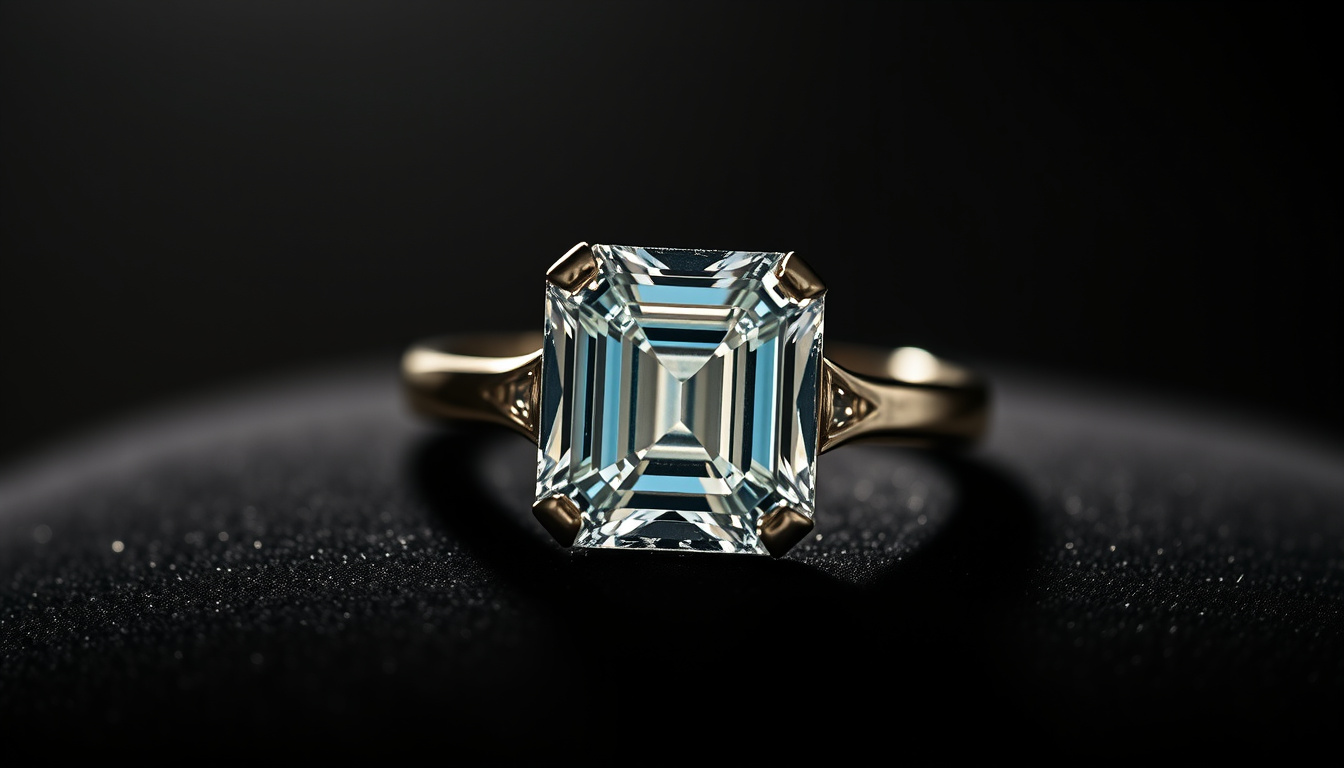
If you’re hunting for an engagement ring that looks expensive without shouting about it, the emerald cut deserves a closer look. Unlike the classic round brilliant, this rectangular shape trades fire and sparkle for something quieter — a clean, architectural elegance that catches light differently. For buyers in Ireland weighing options in 2025, the choice between emerald and other cuts comes down to what you actually value: dazzle or sophistication. The average engagement ring in Ireland costs €3,840, but emerald cuts often land in a different bracket depending on carat and clarity.
Distinctive Feature: Step-cut facets hall of mirrors effect ·
Shape Effect: Elongated flatters finger ·
Common Size Query: 2 carat considered big ·
Top Competitor Focus: Exceptional sparkle symmetry presence ·
SERP Sites Origin: Ireland jewellers .ie domains
Quick snapshot
- Step-cut showcases clarity (Gear Jewellers)
- Less scintillation than brilliant cuts (Appleby Jewellers)
- Exact pricing premiums without specific specs
- 2025 average prices published (Bespoke Diamonds)
- Fields Northern Star reduced to €3,250 (Bespoke Diamonds)
- Lab-grown options expanding at Weir & Sons Dublin
- Price-sensitive buyers shifting to 2ct+ emerald cuts
The following specifications summarise verified market data from Irish retailers for 2025.
| Label | Value |
|---|---|
| Shape Description | Rectangular enhances engagement rings |
| Sparkle Effect | Step-cut facets hall of mirrors |
| Finger Impact | Elongated flatters finger |
| Top Sites | Diamondsfactory.ie Austenblake.ie |
| Avg Ring Price Ireland 2025 | €3,840 |
| Dublin Avg Ring Price | €3,825 |
| Lab Grown Avg Price | €3,100 |
| Natural Avg Price | €6,800 |
| Lab Grown Avg Carat | 2.50ct |
| Natural Avg Carat | 1.20ct |
| Top Regional Price (Wexford) | €4,795 |
| Bottom Regional Price (Tyrone) | €3,585 |
Is an emerald cut diamond more expensive?
Emerald cuts sit in a peculiar pricing position. They require less rough diamond to produce — the step-cut technique wastes less material — which should theoretically make them cheaper than round brilliants of the same carat. But the market doesn’t always behave rationally.
According to Taylor & Hart pricing data, a 1ct emerald cut diamond solitaire in white or yellow gold costs about £4,100, while the same stone in platinum runs roughly £4,150. That premium for platinum is negligible. But jump to 2ct, and the numbers shift dramatically: a 2ct emerald cut in gold costs about £14,850, while platinum pushes to £15,000. Doubling the size costs three to four times more — not double. “Because larger diamonds are more rare, the heavier the diamond, the higher the price,” Taylor & Hart explains.
Compared to the average Irish engagement ring at €3,840, an emerald cut of decent quality easily runs 20–40% above that baseline. The catch is that clarity becomes paramount: the step-cut faces reveal inclusions more readily than brilliant cuts do.
Factors driving emerald cut pricing
The emerald cut’s step-cut faceting pattern — long, parallel facets that run toward the edges — creates its signature “hall of mirrors” effect. This isn’t just aesthetic. The cut genuinely showcases clarity and color more than most other shapes. That means buyers need to invest in higher clarity grades to avoid seeing inclusions through those large, open facets.
Fields offers a Northern Star emerald cut ring that was reduced from €6,500 to €3,250 — a 50% discount that signals how pricing fluctuates based on stock, metal, and stone quality. Diamond Heaven lists white gold emerald cuts starting at €1,055 during sales, dropping to €738.50. Entry-level emerald cuts exist, but they demand careful scrutiny of the 4Cs.
Comparison to round brilliant
Round brilliant cuts remain the most popular globally, which drives both demand and waste. A 1ct round requires roughly 40% more rough diamond to cut than a 1ct emerald. That inefficiency usually pushes round prices higher — but emerald cuts demand better clarity, which adds cost on the stone side.
In practice, a quality emerald cut and a quality round brilliant of identical carat will cost roughly the same, assuming similar clarity and color grades. Where emerald cuts win is visual size: the elongated shape appears larger on the finger than a round of equal carat.
The implication for buyers: if budget is fixed, the emerald cut delivers more visual presence for the same spend, but only if you’re willing to prioritise clarity over size.
For Irish buyers watching budgets, a 1ct emerald cut typically costs less than a comparable round brilliant — but only if you don’t upgrade clarity to compensate for those visible facets. The real expense comes at 2ct and above.
What is the disadvantage of emerald cut?
The “hall of mirrors” effect sounds romantic until you realise what it actually shows: everything. Scratches, inclusions, uneven colour distribution — the emerald cut’s large, open facets are brutally honest.
Unlike brilliant cuts that mask flaws through light refraction, the emerald cut’s step-cut pattern acts like a window into the stone. Gear Jewellers describes the effect as “a captivating hall of mirrors” — which is accurate, but those mirrors also reflect problems. For buyers accustomed to the explosive sparkle of rounds or radiants, the emerald cut can feel disappointingly quiet.
Appleby Jewellers notes that emerald cuts are “loved for their long, rectangular shape and hall-of-mirrors effect” — loved, but not necessarily forgiving. Lower clarity stones (SI1 and below) will show visible inclusions in an emerald cut that would disappear entirely in a brilliant cut of the same grade.
Lower brilliance than round
The round brilliant’s 57 or 58 facets are engineered to maximise light return and create that characteristic “fire” — the rainbow flashes when the stone moves. Emerald cuts typically have 57 facets too, but arranged in concentric, step-like patterns rather than triangular brilliance zones.
The result is less scintillation. Where a round catches light with every tiny movement, an emerald cut requires more deliberate positioning to show its effect. For buyers who want constant sparkle — the kind that photographs brilliantly and catches eyes across a room — the emerald cut underdelivers.
Extends inclusions visibility
Bespoke Diamonds data shows natural diamond rings average 1.20ct, while lab-grown rings average 2.50ct. Emerald cuts appear in both categories, but the larger carat sizes in lab-grown stones make clarity even more critical. A 2ct emerald cut with visible inclusions becomes a distraction rather than an asset.
Weir & Sons Dublin offers lab-grown emerald cuts in the €1,500–€4,000 range, which provides more budget flexibility. But buyers should resist the temptation to sacrifice clarity for size — the step-cut will punish that trade-off.
What this means for buyers: the step-cut architecture punishes clarity compromises more visibly than brilliant cuts, making VS2 or above a practical minimum for anyone considering an emerald cut.
Avoid SI-grade emerald cuts unless the inclusions are positioned away from the table. The large facet windows make every flaw visible. Budget for VS2 or above if choosing emerald. Buyers who ignore this guidance will end up with a stone that looks worse than the grading certificate suggests.
What does an emerald cut ring symbolize?
Beyond the optical properties, the emerald cut carries cultural weight that matters for engagement ring buyers. The shape’s Art Deco heritage — popularised in the 1920s and 1930s — associates it with glamour, sophistication, and deliberate restraint.
Tiffany & Co. has offered emerald cut engagement rings for decades, cementing the shape’s position as a choice for buyers who want elegance over spectacle. In the Irish market, this translates to a demographic that values understated design: buyers who work with their hands and want something that doesn’t catch on gloves, or those who prefer classic aesthetics over trending styles.
The elongated rectangular shape also symbolises longevity and direction — qualities that lend themselves to wedding jewellery designed to last generations. Where round cuts feel timeless in a generic sense, emerald cuts feel specific: Art Deco, architectural, intentionally geometric.
Eternal sophistication
The step-cut pattern originated in gemstone cutting for emeralds themselves — hence the name. Early lapidaries discovered that the parallel facets protected fragile stones from chipping while maximising colour retention. That pragmatic origin became an aesthetic language: clean, measured, architectural.
For modern buyers, that history translates to a cut that doesn’t look trendy. Rounds and pears follow fashion cycles; the emerald cut stays anchored in its geometric precision. Weldons offers a 2.06ct emerald cut in platinum with E colour VVS2 clarity — specifications that signal permanence rather than novelty.
Vintage Art Deco heritage
The Art Deco period (1920–1939) favoured symmetry, geometry, and streamlined forms. Emerald cuts fit perfectly into that visual vocabulary. Jack Kennedy proposed to Jacqueline Bouvier with a 2.88ct emerald cut diamond in 1953 — a choice that reads as both modern for its era and deliberately classic.
For Irish buyers in 2025, the Art Deco association adds a layer of meaning beyond the stone itself. The ring becomes not just jewellery but a design statement referencing a century of elegance. Ellisons in Belfast lists a 1.42ct emerald cut ring at a sale price of £5,995 — the kind of piece that could pass as a family heirloom acquired decades ago.
The catch: buyers who prioritised Art Deco symbolism over practical clarity considerations have learned the hard way that an emerald cut with visible inclusions defeats the sophisticated aesthetic entirely.
If symbolism matters in your purchase decision, the emerald cut communicates intentionality. You’re not defaulting to the most popular shape — you’re choosing a specific aesthetic with historical roots.
Radiant vs. Emerald Cut: Which Diamond Cut Shines More?
The radiant cut and emerald cut share a rectangular outline but diverge dramatically in execution. Radiants are brilliant cuts — designed to maximise sparkle. Emeralds are step cuts — designed to showcase clarity. The result is two completely different visual experiences.
Radiant cuts feature numerous small facets arranged to bounce light chaotically, creating maximum scintillation and fire. Emerald cuts feature fewer, larger facets arranged in concentric rectangles that create the “hall of mirrors” effect. Where a radiant screams sparkle, an emerald whispers elegance.
For clarity grades, the distinction matters. A VS1 emerald cut will appear cleaner than a VS1 radiant cut because the step-cut facets don’t fragment light the way brilliant facets do. But a VVS2 radiant will sparkle dramatically more than a VVS2 emerald. The cut isn’t just about shape — it’s about what you’re prioritising in the stone.
Brilliance and fire differences
Brilliance refers to white light return; fire refers to rainbow light dispersion. Radiant cuts engineer both through their faceting pattern. Emerald cuts sacrifice both for transparency and architectural effect.
In practical terms, this means radiants look better in low-light environments — candlelit dinners, evening events — while emeralds look better in bright, even lighting where their clean lines and transparency shine. For Irish buyers, where the climate leans overcast, this matters practically.
Best for clarity grades
If you’re buying SI1-SI2 clarity to stay within budget, choose radiant. The brilliant cut masks inclusions better. If you’re buying VS2 or above and can see the stone clearly, choose emerald — you’ll actually see that clarity.
Appleby offers 0.70ct emerald cuts that demonstrate how small stones can still make an impact with the right cut. The same carat in radiant might show more sparkle but less architectural presence.
The pattern: buyers who prioritise maximum sparkle should gravitate toward radiant; those who want to showcase stone quality and prefer quieter elegance should choose emerald. Mixing the two preferences leads to disappointment with either cut.
| Cut Type | Sparkle | Clarity Show | Best Light | Best For |
|---|---|---|---|---|
| Emerald | Moderate | Excellent | Bright, even | VS2+ clarity focus |
| Radiant | High | Good | Any lighting | Lower clarity budgets |
| Round Brilliant | Maximum | Moderate | Any lighting | Maximum sparkle priority |
| Oval | High | Moderate | Any lighting | Elongating finger appearance |
How much should I spend on an engagement ring if I make $100,000 a year?
The traditional guideline — two to three months’ salary — originates from De Beers’ 1930s marketing campaigns, not economic reality. But the question keeps surfacing because buyers genuinely want a framework.
For someone earning $100,000 (roughly €92,000), the smarter approach is percentage-based budgeting rather than salary multiples. Most financial advisors suggest 2–5% of annual income for engagement rings. At $100,000, that translates to $2,000–$5,000. Irish buyers earning equivalent euros should consider similar ranges in their currency.
At that budget, what does €2,000–€4,000 buy in emerald cuts? Plenty, if you prioritise correctly. A 1ct emerald cut in white gold from Diamond Heaven runs €738.50 on sale. Bespoke Diamonds offers 1.80ct emerald solitaires in 18ct white gold. That’s more stone than most buyers need at a price that leaves room in the budget for setting and any future upgrades.
Salary-based budgeting rules
The two-to-three-month rule assumes the ring is an investment in marriage commitment. While romantic, it ignores practical realities: housing costs, student debt, shared financial goals. Modern couples increasingly view the ring as one expense among many rather than a singular declaration.
Bespoke Diamonds data shows average engagement ring prices across Irish counties vary significantly. Wexford averages €4,795; Tyrone averages €3,585. Dublin sits at €3,825. Those regional differences reflect local economic conditions and jeweller pricing, not quality differences.
Emerald cut value options
Lab-grown emerald cuts represent the best value at the €2,000–€4,000 budget. Weir & Sons Dublin offers lab-grown options in the €1,500–€4,000 range, and Bespoke Diamonds shows lab-grown rings average 2.50ct compared to 1.20ct for natural stones at similar prices.
For buyers prioritising size without sacrificing cut quality, lab-grown emerald cuts at 2ct+ become viable at price points where natural stones would require significant carat or clarity compromises.
The implication for budget-constrained Irish buyers: lab-grown emerald cuts at 2ct+ deliver the visual presence of natural stones at a fraction of the cost, but only if clarity grades remain high enough to withstand the step-cut’s honest visibility.
Lab-grown stones at 2ct+ let buyers choose emerald cuts for their optical properties rather than accepting smaller stones due to budget. The “hall of mirrors” effect works better on larger facets.
Upsides
- Elongated shape flatters finger visually
- Lower price per carat than round brilliant
- Art Deco heritage adds design credibility
- Excellent for VS2+ clarity showcase
- Lab-grown options provide 2ct+ at €2,000–€4,000
- Large recorded ring approx €78,000 signals market at all tiers
Downsides
- Lower brilliance than round or radiant cuts
- Exposes inclusions in lower clarity grades
- Requires VS2+ for acceptable appearance
- 2ct+ costs 3.6× the 1ct price
- Hall of mirrors effect shows everything
- Less forgiving of everyday wear scratches
The emerald cut’s distinctive step-cut facets create a captivating ‘hall of mirrors’ effect.
— Gear Jewellers (Dublin-based specialist)
Emerald-cut diamonds are loved for their long, rectangular shape and hall-of-mirrors effect.
— Appleby Jewellers (Established specialist)
For Ireland buyers in 2025, the emerald cut occupies a specific niche: sophisticated, architectural, and honest. It rewards those who prioritise clarity and design over raw sparkle. The choice between emerald and radiant ultimately comes down to what you’re buying the stone to show. An emerald cut bought for its Art Deco elegance and Hall of Mirrors effect will delight; bought to maximise sparkle, it will disappoint. Irish buyers earning €92,000 equivalent should target the €2,000–€4,000 range where quality 1.5–2ct emerald cuts with excellent clarity become accessible — particularly through lab-grown options at Weir & Sons and similar Dublin retailers.
Related reading: average engagement ring prices Ireland · diamond investment advice
taylorandhart.com, weldons.ie, fields.ie, diamond-heaven.ie, diamond-heaven.ie, ellisonsjewellers.co.uk, weirandsons.ie, tiffany.ie, weirandsons.ie
Shoppers comparing emerald cuts to radiant styles may find the comprehensive emerald cut guide particularly useful for its detailed pros, cons, and Ireland-specific 2025 advice.
Frequently asked questions
Is a 2 carat ring considered big?
Yes. According to Bespoke Diamonds data, natural diamond rings in Ireland average 1.20ct, while lab-grown rings average 2.50ct. A 2ct emerald cut sits above the natural average, making it a substantial stone that commands attention without being ostentatious.
What is the most popular ring stone?
Round brilliant diamonds remain the global most-popular cut for engagement rings, accounting for roughly 70% of all diamond sales. Emerald cuts hold a dedicated niche market — perhaps 5–10% of engagement ring purchases — appealing to buyers seeking Art Deco aesthetics over maximum sparkle.
Why choose emerald cut for engagement?
Buyers choose emerald cuts for three main reasons: the elongated shape flatters the finger, the Art Deco heritage adds design sophistication, and the step-cut pattern rewards higher clarity grades. If those qualities align with the recipient’s preferences, emerald cuts offer a distinctive alternative to mainstream choices.
How to avoid emerald cut mistakes?
The primary mistake is buying lower clarity to save money. The emerald cut’s large, open facets expose inclusions that brilliant cuts mask. Always prioritise clarity (VS2 minimum) over carat size. The second mistake is expecting round-brilliant sparkle — adjust expectations for the emerald’s quieter, architectural effect instead.
Are emerald cuts vintage style?
Emerald cuts originated in the Art Deco period (1920s–1930s) when the cut was developed to protect fragile emeralds while maximising their colour. The shape has retained that geometric, architectural character ever since. Modern emerald cuts are not reproductions but rather evolved versions of that original vision.
Tiffany emerald cut options?
Tiffany & Co. offers emerald cut engagement rings through their Irish presence (tiffany.ie), representing the premium tier of the market. Prices at Tiffany typically run 30–50% above comparable independent jewellers for equivalent specifications, but the brand carries its own symbolic weight in the luxury goods category.

Thomas Webb leads fact-checking, source verification and corrections at Southern Focus.