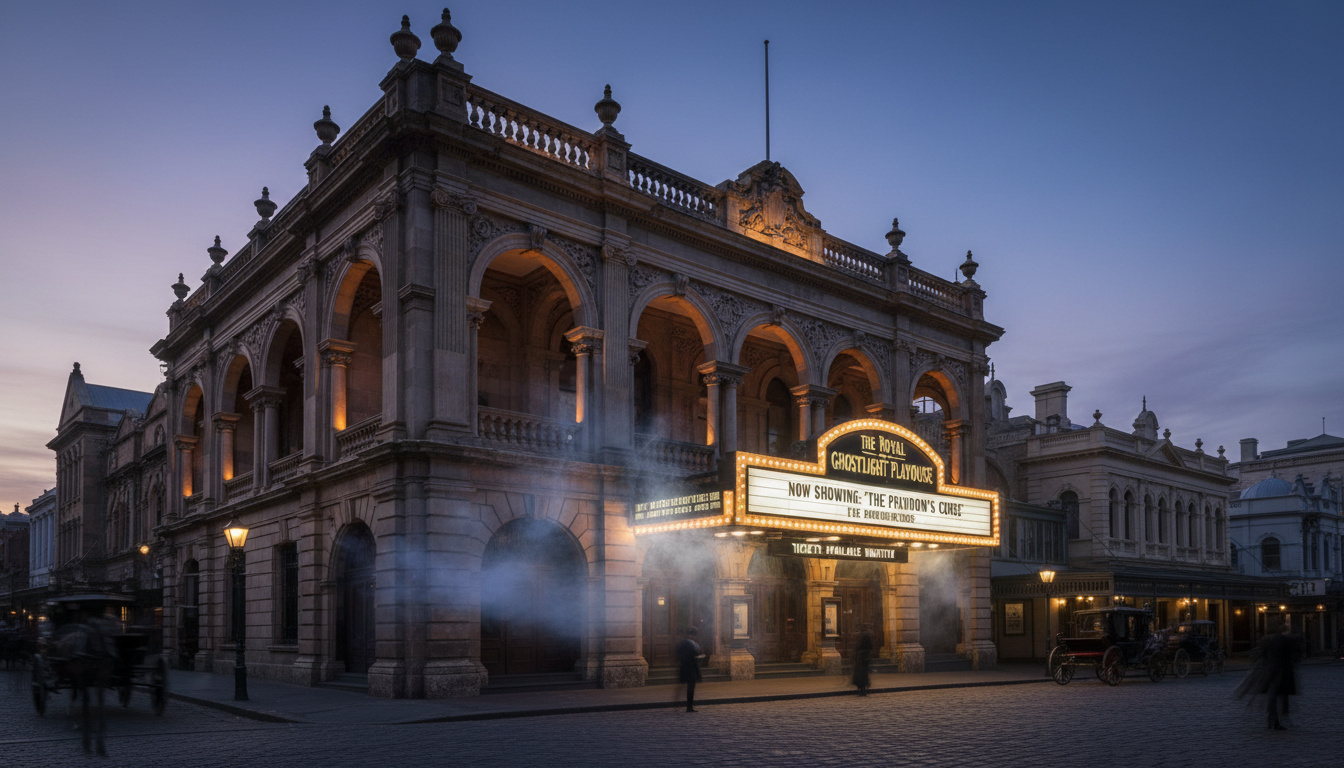
The Princess Theatre stands at 163 Spring Street as Melbourne’s oldest surviving entertainment venue on the Australian mainland, a grand dame of Victorian theatre that first opened its doors in 1854. Rebuilt in 1886 in the exuberant Second Empire style, this 1,452-seat auditorium has hosted everything from the Australian premiere of The Mikado to record-breaking runs of Les Misérables and The Phantom of the Opera.
Beyond its architectural significance and theatrical pedigree, the venue carries a reputation that extends into the supernatural. The ghost of Frederick Federici, a baritone who collapsed on stage in 1888, remains one of Melbourne’s most enduring cultural legends, while conservation efforts continue to preserve the building’s ornate heritage details.
Today, the theatre operates under the Marriner Group, maintaining its 170-year tradition as a cornerstone of the city’s East End Theatre District.
What is the History of Princess Theatre Melbourne?
Key Historical Insights
- Australia’s oldest surviving mainland entertainment venue, originally opening as Astley’s Amphitheatre
- 1886 complete rebuild by architect William Pitt in exuberant Second Empire style at a cost of £50,000
- Site of baritone Frederick Federici’s fatal on-stage collapse during Don Giovanni in 1888
- Featured innovative electric stage lighting and the world’s first sliding ceiling mechanism
- Hosted Victoria’s longest-running musical, The Phantom of the Opera, following its 1989 reopening
- Restored to its 1922 architectural grandeur during the 1986-1989 Marriner Group renovation
- Heritage-listed example of Melbourne’s “Marvellous Melbourne” boom-era architecture
Essential Facts
| Original Name | Astley’s Amphitheatre (1854) |
|---|---|
| 1886 Construction Cost | £50,000 |
| Architect | William Pitt (interiors by George Gordon) |
| Seating Capacity | 1,452 |
| Architectural Style | Second Empire |
| Major Renovations | 1857, 1877, 1886, 1922, 1986-1989 |
| Builders | Cockram and Comely (1886 rebuild) |
Where is Princess Theatre Melbourne and How Do You Get There?
The Princess Theatre occupies a prominent position at 163 Spring Street, on the corner of Little Bourke Street, within Melbourne’s central business district. This location places it within the historic Spring Street Victorian streetscape, adjacent to Parliament House and the Treasury Gardens.
Public Transport Options
The venue sits within the Free Tram Zone, serviced by routes along Spring Street and nearby Bourke Street. Parliament Railway Station, served by the Lilydale, Belgrave, Alamein, Glen Waverley, and Pakenham lines, provides the closest heavy rail access, located approximately two blocks south of the theatre.
Tram services along Spring Street stop within 100 metres of the entrance. Parliament Station offers step-free access via lifts, connecting directly to the theatre precinct.
Parking and Venue Access
The theatre itself does not maintain a dedicated parking facility. Visitors typically utilise nearby multi-level car parks along Little Bourke Street or Spring Street, though specific parking maps and real-time availability are not documented in public records. Street parking follows standard Melbourne CBD restrictions and meters.
Those familiar with venue access challenges in other Australian cities might consider reviewing the Raine Square Cinema – Perth Guide to Parking and Showtimes for comparative parking strategies in heritage precincts.
What Shows and Events Are On at Princess Theatre Melbourne?
Throughout its history, the Princess Theatre has served as a premiere venue for major theatrical productions. The 1886 reopening featured The Mikado, while the 1989 restoration premiere hosted Les Misérables. The venue subsequently hosted the Victorian record-breaking production of The Phantom of the Opera.
Current Programming and Tickets
Contemporary bookings and event calendars are managed exclusively through the Marriner Group. Historical records confirm the theatre specialises in large-scale musicals and dramatic productions utilising the full technical capabilities of the 1886 auditorium, including its modernised lighting and stage systems installed during the 1986-1989 refurbishment.
For current programming, patrons should consult the official Marriner Group website, as performance schedules rotate regularly and availability is subject to change.
Is Princess Theatre Melbourne Haunted? The Ghost Story Explained
The theatre’s supernatural reputation centres on Frederick Federici, a baritone who suffered a fatal heart attack on March 3, 1888, immediately following his final aria as the Commendatore in Don Giovanni. According to historical accounts, Federici collapsed into the arms of castmates while taking his bows, his death unknown to the audience until after the performance concluded.
The Legend and Reports
For over 135 years, staff, performers, and audiences have reported unexplained phenomena, including odd noises, shadowy figures near the stage, and sudden temperature changes. Contemporary documentation notes that Federici is traditionally described as appearing in formal evening attire, consistent with his costume on the night of his death.
Contemporary newspaper reports and theatre archives confirm Federici’s death occurred on stage following the performance. However, no physical evidence of spectral activity has been scientifically verified.
While the Federici death is a matter of historical record, reports of ongoing supernatural phenomena remain anecdotal. The theatre officially acknowledges the legend as part of its cultural heritage.
Princess Theatre Melbourne Seating Plan, Capacity, and Best Seats
The auditorium accommodates 1,452 patrons across multiple levels, configured during the 1886 rebuild to maximise sightlines while preserving the intimate atmosphere characteristic of Victorian theatre design. Paint investigations by heritage conservationists confirm the original Second Empire decorative scheme remains intact throughout the seating tiers.
Seating Configuration
Available sources do not provide detailed seating charts or specific recommendations for optimal viewing positions. The 1886 design by William Pitt originally incorporated innovations including electric lighting and a sliding ceiling mechanism, suggesting careful attention to audience sightlines was fundamental to the architecture.
Dress Code and Attendance
No specific dress code is mandated in public documentation for the Princess Theatre. Standard theatre etiquette applies, with most patrons opting for smart casual to formal attire depending on the performance type and timing.
When Was Princess Theatre Melbourne Built? A Complete Timeline
- 1854: Opens as Astley’s Amphitheatre on the corner of Spring and Little Bourke Streets, hosting equestrian shows and concerts alongside the Mazeppa Hotel.
- 1857: Extensively renovated with an extended facade, reopening as Princess’s Theatre and Opera House on April 16 under manager John Black.
- 1877: Refitted and reopened December 28 as the New Princess Theatre under the management of L.M. Bayless.
- 1886: Demolished and completely rebuilt by William Pitt in exuberant Second Empire style at a cost of £50,000; reopened December 18 with The Mikado.
- 1922: Altered by William Pitt, updating facilities while maintaining the Second Empire facade.
- 1986-1989: Purchased by David Marriner and restored to its 1922 state with technical upgrades; reopened December 9, 1989, with Les Misérables.
What is Known and Uncertain About Princess Theatre Melbourne?
Established Facts
- Physical address at 163 Spring Street, Melbourne
- Construction dates: 1854 original, 1886 rebuild
- Architectural style: Second Empire by William Pitt
- Capacity: 1,452 seats
- Frederick Federici’s death on March 3, 1888 (heart attack)
- Renovation years: 1857, 1877, 1886, 1922, 1986-1989
Unclear or Unspecified
- Specific dedicated parking facilities (general CBD only)
- Precise optimal seating positions within the auditorium
- Detailed dress code requirements beyond general etiquette
- Scientific verification of modern ghost sightings
- Current accessibility specifications beyond standard venue compliance
Why Does Princess Theatre Melbourne Matter?
The Princess Theatre represents a physical manifestation of Melbourne’s “Marvellous Melbourne” era, the booming period following the Victorian gold rush that saw the city develop its distinctive architectural character. As Heritage Victoria notes, the building forms an essential component of Spring Street’s intact Victorian streetscape, offering rare insight into 19th-century entertainment architecture.
The venue’s continuous operation since 1854—spanning from horse circuses to digital-age musicals—establishes it as Australia’s longest-running mainland entertainment site. Its 1886 innovations, including electric stage lighting, positioned Melbourne at the forefront of global theatrical technology.
For those examining Melbourne’s cultural infrastructure compared to other Australian entertainment venues, the Perth Scorchers vs Melbourne Renegades Match Scorecard – Full BBL 2024/25 Stats & Result illustrates the city’s broader sporting and entertainment landscape, though the Princess Theatre remains distinct in its focus on performing arts heritage.
What Do Official Records Document?
The baritone Frederick Federici collapsed on stage in 1888 following his final aria, his death unbeknownst to the audience until the performance concluded. Contemporary medical records confirm the fatal heart attack occurred immediately after his bow.
Historical Theatre Archives via Wikipedia and Atlas Obscura
The 1886 rebuild featured electric stage lighting and the world’s first sliding ceiling, innovations that positioned the venue at the technological forefront of global theatre design.
ICS Conservation Heritage Reports
How Can You Experience Princess Theatre Melbourne?
Visitors seeking to experience this heritage venue should consult the Marriner Group for current performance schedules and availability. The theatre’s location at 163 Spring Street places it within walking distance of Melbourne’s parliamentary precinct and major hotel districts. Given the limited specific parking information available, public transport remains the most reliable access method for evening performances.
Frequently Asked Questions
When was Princess Theatre Melbourne built?
The original structure opened in 1854 as Astley’s Amphitheatre. The current building dates to 1886, when architect William Pitt completed a full rebuild in the Second Empire style.
What is the capacity of Princess Theatre Melbourne?
The theatre seats 1,452 patrons across its stalls and circle levels, as confirmed in heritage documentation and archival records.
What is the dress code at Princess Theatre Melbourne?
Public sources do not specify a mandatory dress code. General theatre etiquette applies, with most attendees wearing smart casual to formal attire depending on the performance.
How do you book tickets for Princess Theatre Melbourne?
Tickets are managed exclusively through the Marriner Group website. The venue does not operate a direct box office outside of this system.
Is there parking at Princess Theatre Melbourne?
The theatre does not maintain dedicated parking. Visitors utilise nearby multi-level car parks and street parking in the CBD, subject to standard Melbourne parking restrictions.
Related stories




Liam O'Brien covers Australian politics and public affairs for Southern Focus.