
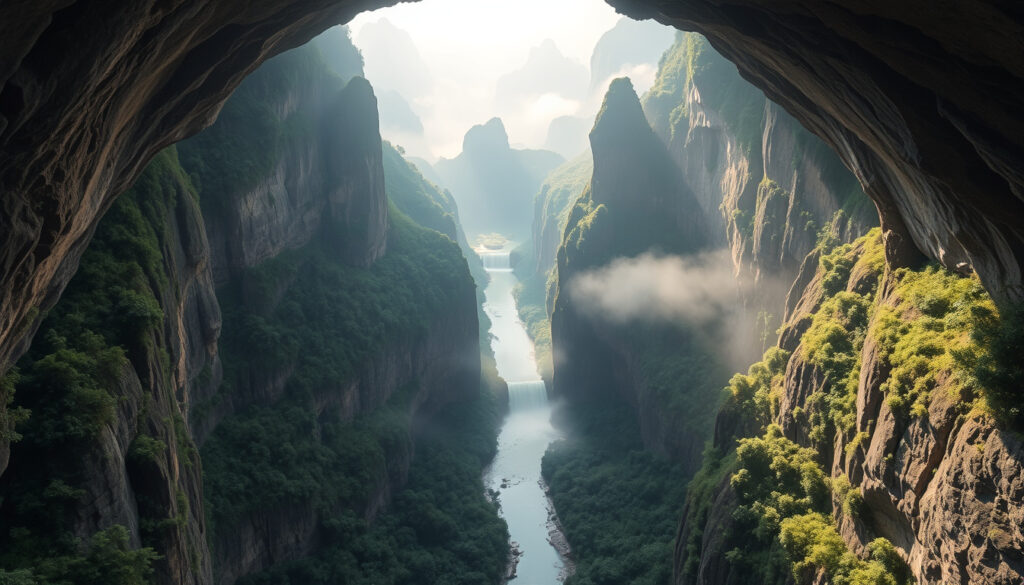
You don’t have to be a caver to get chills at the thought of a cave with its own weather system. When a local farmer named Ho Khanh first stumbled into the entrance of what would become known as Son Doong Cave in 1991, he couldn’t have known he’d found the largest natural cave on Earth—a 9-kilometer-long void that could swallow a New York City block whole.
Volume: 38.5 million cubic meters ·
Length: 9 km ·
Height: up to 200 m ·
Discovery: 1991 by Ho Khanh ·
Tour Price: approx. $3,000
Quick snapshot
- World’s largest cave by volume (Vietnam Airlines travel guide)
- 9 km long (Vietnam Airlines travel guide)
- Chambers up to 200 m high (Vietnam Airlines travel guide)
- Found by Ho Khanh in 1991 (Vietnam Airlines travel guide)
- Explored by British caving team in 2009 (Vietnam Airlines travel guide)
- Opened to public in 2013 (Vietnam Airlines travel guide)
- Only operated by Oxalis Adventure (Vietnam Airlines travel guide)
- 5-6 day expedition (Oxalis Adventure (official tour operator))
- Costs approx. $3,000 per person (Oxalis Adventure pricing)
- Has own rainforest (Vietnam Airlines travel guide)
- Underground river (Vietnam Airlines travel guide)
- Unique flora and fauna (Vietnam Airlines travel guide)
Son Doong is not just big—it’s big enough to hold a 40-story building inside its largest chamber. For the price of a used car, you can walk through a place that existed untouched for millions of years.
The facts below confirm the staggering scale of this geological anomaly.
| Fact | Value |
|---|---|
| Location | Phong Nha, Vietnam (Vietnam Airlines travel guide) |
| Volume | 38.5 million cubic meters (Vietnam Airlines travel guide) |
| Length | 9 km (Vietnam Airlines travel guide) |
| Height | 200 m (Vietnam Airlines travel guide) |
| Discovery Year | 1991 (Vietnam Airlines travel guide) |
| Tour Cost | ~$3,000 (Oxalis Adventure pricing) |
| Operator | Oxalis Adventure (Vietnam Airlines travel guide) |
What is special about Son Doong cave?
Size and scale
Son Doong’s volume of 38.5 million cubic meters makes it the largest natural cave on the planet by volume, according to the Vietnam Airlines travel guide. The cave stretches more than 9 kilometers in length, with sections reaching 200 meters in height and 150 meters in width. To put that in perspective: you could fit a Boeing 747 end-to-end inside the main passage—twice.
The implication: Son Doong’s dimensions redefine what a cave can be, rivaling the scale of underground cities.
Unique ecosystem
The cave contains its own rainforest, an underground river, and unique flora and fauna that have adapted to perpetual darkness (Vietnam Airlines travel guide). Sunlight streaming through collapsed ceilings (dolines) nurtures lush vegetation, creating a self-contained world.
Discovery story
In 1991, local farmer Ho Khanh was hunting for timber in the forest when he stumbled upon the cave entrance. He didn’t explore it further until 2009, when he guided a British caving team from the British Cave Research Association to the site. Their survey confirmed it as the world’s largest cave (Vietnam Airlines travel guide).
Why is Son Doong cave so expensive?
Limited access and permits
Independent access to the cave is strictly prohibited. All expeditions must be conducted through a licensed operator with certified guides (Vietnam Airlines travel guide). The government limits the number of tourists to about 1,000 per year to minimize environmental impact.
Duration and logistics
The expedition is a multi-day affair: Oxalis Adventure, the only authorized operator, runs a 6-day, 5-night journey (Oxalis Adventure tour page). This includes camping inside the cave, porters carrying supplies, and specialized safety equipment.
Exclusive tour operator
Oxalis Adventure holds the exclusive permit from the Quang Binh provincial government to operate tours in Son Doong (Vietnam Airlines travel guide). No other company can legally take you inside, cementing a monopoly that keeps prices high.
The high price isn’t just about exclusivity—it finances conservation. Each ticket includes management and supervision fees that directly fund the protection of the cave ecosystem. Without those costs, the cave might not survive heavy traffic.
How much does Son Doong cave cost?
Tour prices
The standard Son Doong Expedition costs US$3,000 per person according to Oxalis Adventure. The Vietnam Airlines travel guide corroborates this figure, noting it’s subject to seasonal demand and booking time. Some third-party sources, such as Handspan (travel agency), list the cost at about 72 million VND (around $3,000), while a Facebook group post reportedly mentions 60 million VND, though this is unverified.
What’s included
According to Oxalis Adventure, the $3,000 price includes VAT, entrance fee, environmental service fee, management fee, and supervision. Meals, camping gear, porters, and guides are also covered.
Additional expenses
Flights to Vietnam and accommodation in Dong Hoi or Phong Nha are not included. You’ll also need travel insurance that covers adventure activities—something most standard policies exclude. Factor in at least an extra $500–1,000 for these costs.
If you pay $3,000, you get a fully supported expedition with permits, safety, and environmental fees baked in. If you try to go cheaper, you’d be breaking the law—and possibly risking your safety in one of Earth’s most remote underground environments.
Are there tigers in Son Doong cave?
Wildlife inside the cave
No large predators like tigers have been reported inside Son Doong. The cave is home to bats, insects, and snakes—including the cave-adapted species that survive in near-total darkness (Vietnam Airlines travel guide). The underground river supports fish and invertebrates.
Common animals
Visitors most commonly see cave swiftlets, blind cave fish, and various arthropods. The rainforest sections that receive sunlight have more typical forest fauna, including monkeys and birds, but these stay near the cave entrances.
Safety precautions
Oxalis Adventure provides helmets, headlamps, and experienced guides. The biggest risks are slips on wet rocks and fatigue, not wildlife encounters. No large mammals have been documented deep inside the cave.
Can tourists go to Son Doong cave?
How to get there
Son Doong is located in Phong Nha-Ke Bang National Park, about 70 kilometers from Dong Hoi City (Vietnam Airlines travel guide). The nearest international airport is Dong Hoi (VDH), with flights from Hanoi and Ho Chi Minh City. For those coming from Australia, consider Sydney to Hanoi flights as a first leg, then a domestic connection.
Tour requirements
Booking must be made months in advance through Oxalis Adventure. Each tour is limited to 10 participants (Oxalis Adventure tour page). Participants must be at least 16 years old, physically fit, and able to hike 12–16 km per day over rugged terrain.
Fitness and age limits
You don’t need to be an elite athlete, but you should be comfortable with steep climbs, tight squeezes, and camping in basic conditions. A medical check is required before booking. The cave is not wheelchair accessible, and anyone with heart or respiratory conditions should consult their doctor.
Annual visitor caps mean that tours sell out quickly—Oxalis typically releases slots once a year. If you want to go, start planning 6–12 months ahead.
Timeline
- 1991: Ho Khanh discovers the cave entrance (Vietnam Airlines travel guide).
- 2009: British caving team, led by Howard Limbert, conducts the first full exploration (Vietnam Airlines travel guide).
- 2013: First public tours are offered by Oxalis Adventure (Oxalis Adventure).
- 2020: Visitor regulations tightened due to environmental concerns, further limiting annual numbers.
What we know and what remains unclear
Confirmed facts
- Son Doong is the world’s largest cave by volume (38.5 million cubic meters) (Vietnam Airlines travel guide).
- It is located in Phong Nha-Ke Bang National Park, Vietnam (Vietnam Airlines travel guide).
- Discovered by Ho Khanh in 1991 (Vietnam Airlines travel guide).
- Oxalis Adventure is the sole authorized tour operator (Vietnam Airlines travel guide).
What’s unclear
- Whether undiscovered passages exist—exploration continues (Vietnam Airlines travel guide notes ongoing surveys).
- The exact number of species inhabiting the cave—new species are still being found.
- The long-term environmental impact of tourism—monitoring is in place but long-term data is limited.
Voices from the cave
“I saw the cave entrance on a hillside, but I didn’t go inside because I was afraid. Later, I told the British team about it and they asked me to take them there.”
— Ho Khanh, discoverer of Son Doong Cave, as recounted in Vietnam Airlines travel guide
“The expedition is physically demanding. You’re hiking through jungle, crossing rivers, and camping in the cave. It’s not a luxury tour—it’s an authentic adventure.”
— Oxalis Adventure guide, as described on the Oxalis Adventure tour page
Summary
Son Doong Cave challenges our definition of “cave” with its scale, ecosystem, and exclusivity. The memory of standing in a subterranean rainforest—with a river flowing beside you—will outlast any $3,000 investment for adventure travelers who step inside.
For a comprehensive overview of this natural wonder, including tour logistics and safety tips, check out this detailed Son Doong Cave guide.
Frequently asked questions
How was Son Doong cave discovered?
It was discovered in 1991 by local farmer Ho Khanh while he was searching for timber. He found the entrance but didn’t explore it further until 2009, when he guided a British caving team to the site (Vietnam Airlines travel guide).
What is the best time to visit Son Doong cave?
The dry season from February to August is ideal. Heavy rain from September to January can cause flooding inside the cave, and tours are rarely scheduled during the wet months (Oxalis Adventure).
Is Son Doong cave safe for tourists?
Yes, when accompanied by Oxalis Adventure’s trained guides. The biggest risks are physical exertion and slippery surfaces, not wildlife. Helmets and headlamps are provided (Oxalis Adventure).
What should I pack for a Son Doong cave tour?
Oxalis provides equipment, but you’ll need sturdy hiking boots, quick-dry clothing, a waterproof jacket, insect repellent, and a headlamp. A small daypack is recommended for essentials.
How long is the Son Doong cave tour?
The standard expedition is 6 days and 5 nights, including travel to and from the cave, camping inside, and a full day of exploration on foot (Oxalis Adventure).
What is the weather inside Son Doong cave?
The cave maintains a stable temperature of about 20°C (68°F) year-round. Humidity is high, and some sections have strong airflow. The underground river can be cold—around 16°C (61°F).
Are there age or fitness requirements?
Participants must be at least 16 years old. A reasonable level of fitness is required: expect daily hikes of 12–16 km over steep and uneven terrain. A medical screening is mandatory before booking.

Thomas Webb leads fact-checking, source verification and corrections at Southern Focus.