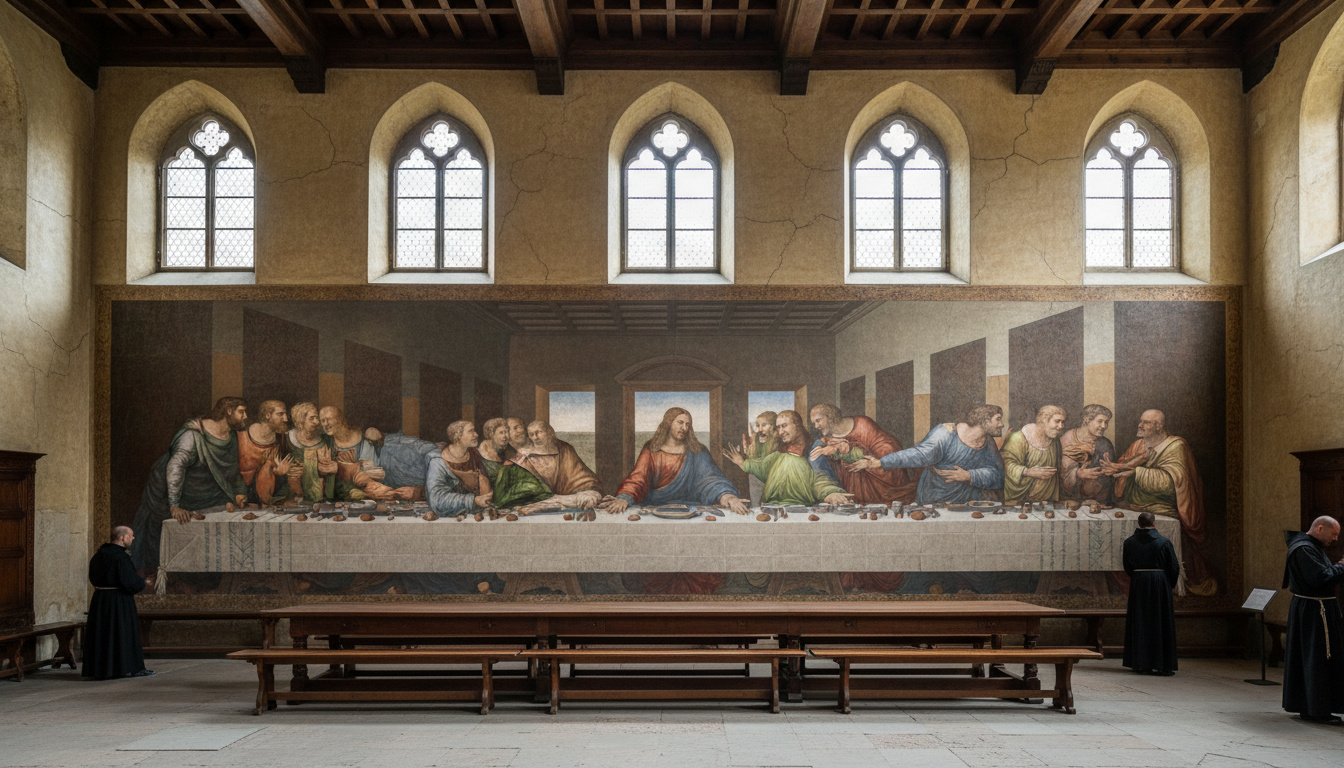
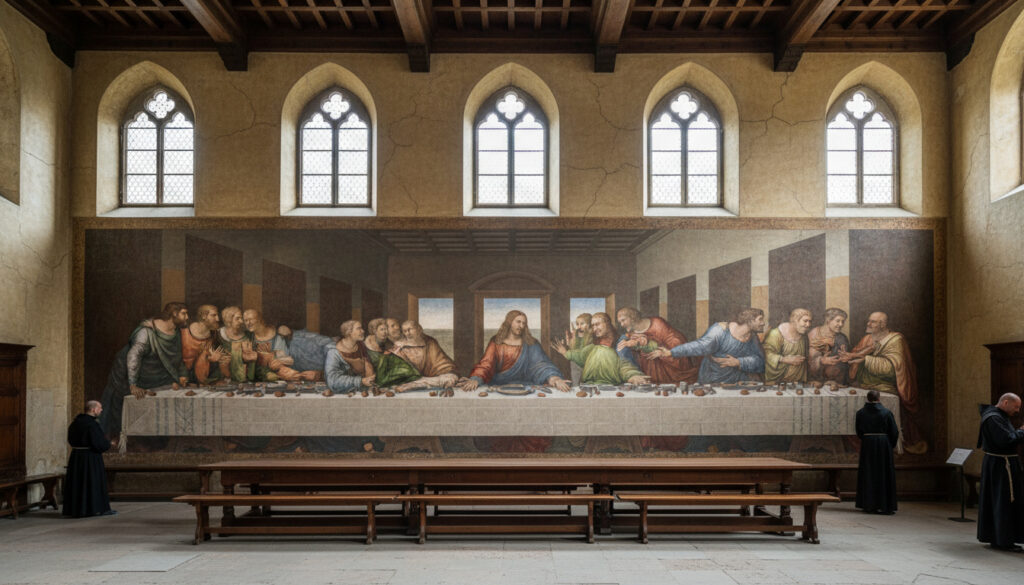
The Last Supper stands as Leonardo da Vinci’s monumental mural depicting the biblical moment when Jesus Christ announces his impending betrayal. Created between approximately 1495 and 1498, this masterpiece occupies the refectory wall of the Santa Maria delle Grazie convent in Milan, Italy, measuring 460 by 880 centimeters. Unlike traditional frescoes, Leonardo employed an experimental technique using tempera on a dry wall sealed with gesso, pitch, and mastic, allowing for greater detail but ultimately contributing to the work’s rapid deterioration.
Commissioned by Ludovico Sforza, Duke of Milan, the painting served as both a devotional centerpiece and a display of ducal power, incorporating the Sforza coat of arms into the architectural lunettes above the scene. The work captures the precise instant described in the Gospel of John 13:21, where Jesus declares that one of his twelve apostles will betray him, freezing the figures in a moment of psychological tension and emotional reaction that revolutionized Renaissance art.
Today, the mural attracts over 500,000 visitors annually to the Museo del Cenacolo Vinciano, requiring advance reservations due to strict climate controls necessary for preservation. Its inclusion as a UNESCO World Heritage Site in 1980 acknowledges its universal artistic value and enduring influence on Western visual culture.
What Is The Last Supper?
Leonardo da Vinci
Santa Maria delle Grazie, Milan
c. 1495–1498
Tempera on gesso, pitch, mastic
- Revolutionary one-point perspective converging on Christ’s right temple
- Experimental dry technique caused premature deterioration
- Captures the psychological moment of betrayal announcement
- UNESCO World Heritage Site designation since 1980
- Strict 15-minute viewing slots to limit environmental exposure
- Largest work by Leonardo excepting the Sala delle Asse
| Artist | Leonardo da Vinci |
| Created | c. 1495–1498 |
| Dimensions | 460 cm × 880 cm (15 × 29 feet) |
| Location | Santa Maria delle Grazie, Milan, Italy |
| Medium | Tempera and oil on dry wall |
| Commissioned by | Ludovico Sforza, Duke of Milan |
| Biblical source | Gospel of John 13:21 |
| UNESCO status | World Heritage Site (1980) |
| Restoration | Completed 1999 (20-year project) |
| Viewing capacity | Limited small groups only |
Art historians recognize the work as marking a decisive shift in Renaissance painting, moving from static, symbolic representations to dynamic scenes of human emotion. Scholarly analysis confirms that Leonardo worked slowly with frequent pauses, studying light, motion, and human psychology to achieve unprecedented realism in the figures’ expressions and gestures.
Where Is The Last Supper Located and How Can You Visit?
The Santa Maria delle Grazie Setting
The mural occupies the north wall of the convent’s refectory, the dining hall where Dominican friars once took their meals. This placement creates a unique continuity between the painted scene and the physical space; Leonardo designed the perspective to extend the actual architecture, making the depicted room appear as a continuation of the real one. The integration of the artwork with its architectural setting represents a deliberate artistic choice to blur the boundary between painted illusion and lived space.
Booking Requirements and Access
Access requires advance reservations through the official museum system due to strict conservation protocols. Visitors enter in small groups for precisely timed 15-minute intervals, designed to minimize humidity and temperature fluctuations that could further damage the fragile surface. The museum maintains constant climate monitoring to preserve what remains of Leonardo’s original pigments.
Tickets typically sell out three months in advance during peak tourist seasons. The official booking platform releases entries in quarterly waves, and same-day tickets are virtually unavailable. Visitors should verify availability through the museum’s official reservation system before making travel arrangements to Milan.
Photography and Viewing Policies
Photography of any kind is strictly prohibited within the refectory to prevent flash damage and reduce visitor movement that might stir dust. Security personnel enforce this rule consistently. The brief viewing window encourages focused observation of specific details—the translucent windows, the spilled salt cellar, the various hand gestures—before the group exits through a separate corridor.
What Happened at the Biblical Last Supper?
The Moment of Betrayal
The painting illustrates the specific narrative from the Gospel of John 13:21, immediately following the washing of the feet, where Jesus announces that one disciple present will betray him. This differs from the institution of the Eucharist depicted in the Synoptic Gospels, focusing instead on the psychological shockwave of the betrayal revelation. The scene captures the instant after the announcement but before the identification of Judas, creating a suspended moment of collective uncertainty.
The Figures and Their Reactions
Jesus sits centrally, isolated in a triangular composition that draws the eye to his right temple—the vanishing point for the entire perspective system. The twelve apostles react in four distinct groups of three, displaying what Leonardo termed “motions of the soul” through gestures and postures. Documentary sources indicate Leonardo used local Milanese residents as models to achieve authentic emotional expressions, including reportedly seeking a criminal with appropriate features to portray Judas.
Judas appears distinct from the others—shadowed, recoiling, and notably without a halo—clutching a small bag that presumably contains the thirty pieces of silver. His positioning on the near side of the table, separate from the other apostles, visually reinforces his isolation despite his physical proximity to Jesus and John.
Why Is The Last Supper Famous?
Revolutionary Perspective
Leonardo’s mastery of linear perspective creates a mathematically precise illusion of depth. All architectural lines—ceiling beams, tapestries, window frames—converge at a single vanishing point located behind Jesus’s head, subconsciously emphasizing his centrality to the narrative. Technical analysis reveals this was calculated to align with the actual eye level of viewers standing in the refectory, creating an immersive spatial experience.
Leonardo employed sfumato—the subtle gradation of tones and colors without harsh outlines—to create soft shadows and atmospheric depth. This technique, combined with his observation of how light falls on three-dimensional forms, produces figures that seem to occupy real space rather than flat pictorial surface.
Emotional Psychology
Prior to Leonardo, Last Supper depictions typically showed static, sedate figures arranged in a row. Leonardo revolutionized the subject by capturing explosive emotional reactions: Matthew gestures wildly, Philip points to himself in questioning innocence, while Thomas raises his characteristic finger. Each apostle responds according to his established biblical personality, creating a study in individual psychology within a collective drama.
Cultural Impact
The work established a new visual vocabulary for depicting narrative tension in religious art. Its influence extends through centuries of Western art, informing approaches to group composition, emotional expression, and the integration of architecture with painted space. The Royal Academy notes that the painting represents the pinnacle of High Renaissance experimentation with the relationship between art and viewer.
What Technique Was Used and Its Restoration History?
- : Ludovico Sforza commissions the work as part of monastery renovations and his planned mausoleum.
- : Leonardo completes the painting after working intermittently for three years.
- : Renovators cut a doorway through the lower center of the mural, permanently removing Jesus’s feet from the composition.
- : Napoleon’s troops occupy Milan and use the refectory as a stable, subjecting the work to humidity and neglect.
- : Allied bombing damages the convent during World War II; the mural survives but remains exposed to the elements for months.
- : A controversial 20-year restoration concludes, removing centuries of grime and overpainting while adding watercolor to lost areas.
Leonardo rejected traditional fresco techniques that required rapid painting on wet plaster. Instead, he sealed the wall with gesso, pitch, and mastic, then painted with tempera and oil. This allowed him to work slowly and achieve subtle effects, but the materials never properly bonded with the wall, causing the paint to begin flaking within Leonardo’s own lifetime.
The 1999 restoration documented in conservation records remains contentious among art historians. Critics argue that the extensive inpainting obscures what little original pigment survived, while proponents maintain that the removal of darkened varnishes revealed Leonardo’s intended luminosity. The restoration team added beige watercolor to distinguish restoration from original paint, a practice that allows viewers to see the composition’s full extent while acknowledging losses.
What Is Established and What Remains Uncertain?
| Established Facts | Unresolved Questions |
|---|---|
| Leonardo da Vinci is the sole artist | Exact completion date in 1498 |
| Location at Santa Maria delle Grazie | Original color vibrancy before deterioration |
| Biblical source: Gospel of John 13:21 | Identity of all twelve apostles depicted |
| Commissioned by Ludovico Sforza | Whether the figure beside Jesus is John or Mary Magdalene |
| Dimensions: 460 cm × 880 cm | Extent of Leonardo’s original underdrawing |
| Technique: Tempera on sealed dry wall | Specific models used for each apostle |
What Is the Historical Context?
The Last Supper emerged during the height of the Italian Renaissance, specifically within the court culture of Milan under Ludovico Sforza. The commission formed part of extensive renovations to the Dominican convent, intended simultaneously as a religious statement and dynastic propaganda. Sforza’s coat of arms appears prominently in the lunettes, asserting his patronage and political authority through association with this sacred narrative. For those interested in the broader context of Renaissance art and its historical significance, you can find Milan news today and explore other fascinating cultural developments. Milan news today
Leonardo’s approach reflected humanist interests in psychology, optics, and anatomy that characterized the period. His notebooks reveal extensive preparation, including studies of facial expressions, hand gestures, and architectural perspective. The artist’s methodical pace frustrated his patron; the convent prior reportedly complained to Sforza about delays, prompting Leonardo’s famous retort that he was seeking the perfect face for Judas and might use the prior himself as the model.
The work’s creation paralleled Leonardo’s other Milanese projects, including engineering works and the Princess Theatre Melbourne History, demonstrating the interdisciplinary nature of Renaissance artistic practice. While the painting deteriorated rapidly due to its experimental technique, contemporaries immediately recognized its innovation. Giorgio Vasari’s 1550 account praised the majesty of the apostles while noting that Leonardo deliberately left Christ’s head imperfect, believing he could not adequately depict divine perfection.
What Do Historical Records Reveal?
“It is a beautiful and marvelous thing to see the figure of Christ, so full of majesty, and the apostles, all alive and moved by different passions.”
— Giorgio Vasari, Lives of the Artists (1550)
“How despairing Judas is! He does not stand up like the others, but remains seated, turning away from Jesus, and shrinking against the table.”
— Contemporary observation on the emotional realism
How Can You Experience The Last Supper Today?
Planning a visit requires securing reservations well in advance through the official Museo del Cenacolo Vinciano website, as the fragile condition necessitates strict visitor limits. The 15-minute viewing window demands preparation—studying the composition beforehand allows visitors to locate specific details like the spilled salt or Judas’s overturned bag rather than attempting to absorb the entire scene at once. Combining the visit with other Milanese Renaissance sites provides fuller context for Leonardo’s work and legacy. Those interested in Type 2 Diabetes Symptoms should consult medical resources when preparing for travel.
Common Questions
How long did it take Leonardo to paint The Last Supper?
Leonardo worked on the mural from approximately 1495 to early 1498, though he painted intermittently rather than continuously. His slow pace and frequent pauses to study light and emotion frustrated his patron.
Can you take photos of The Last Supper?
No. Photography is strictly prohibited in the refectory to protect the fragile pigments from flash damage and reduce environmental disturbance. Security enforces this policy consistently.
What technique did Leonardo use?
Leonardo used tempera and oil on a dry wall sealed with gesso, pitch, and mastic rather than traditional fresco. This experimental technique allowed greater detail but caused rapid deterioration.
Who commissioned The Last Supper?
Ludovico Sforza, Duke of Milan, and his wife Beatrice d’Este commissioned the work in the mid-1490s as part of monastery renovations intended to include Sforza’s mausoleum.
Why did the painting deteriorate so quickly?
The experimental dry technique prevented proper bonding between pigment and wall. Combined with humidity, wartime exposure, and previous restoration attempts using varnishes and solvents, the paint began flaking within decades.
How big is The Last Supper?
The mural measures 460 centimeters high by 880 centimeters wide, approximately 15 by 29 feet, making it Leonardo’s largest work aside from the Sala delle Asse.
Is John actually Mary Magdalene in the painting?
Art historians generally identify the figure beside Jesus as John the Evangelist, based on Renaissance iconography and Leonardo’s preparatory studies. The Mary Magdalene theory remains speculative and lacks documentary support.

Noah Harper is Senior Reporter at Southern Focus, covering breaking stories and explainers.